The global venture capital landscape in the second quarter of 2026 has revealed a stark, bifurcated reality. While headline figures suggest a robust recovery in funding, a deeper analysis reveals a market characterized by extreme capital concentration, shrinking deal volume, and a profound shift in geopolitical investment priorities. As the tech ecosystem grapples with these imbalances, the record-breaking performance of Europe’s defense sector—highlighted by Helsing’s massive Series E—offers a glimpse into a new era of "hard tech" supremacy.
The State of Global Funding: A Mirage of Growth?
On the surface, the second quarter of 2026 appeared to be a triumph for the innovation economy, with total global funding reaching $212.9 billion—the second-highest quarter on record. However, this statistic is heavily distorted by a handful of "mega-rounds" that have fundamentally altered the mechanics of venture financing.
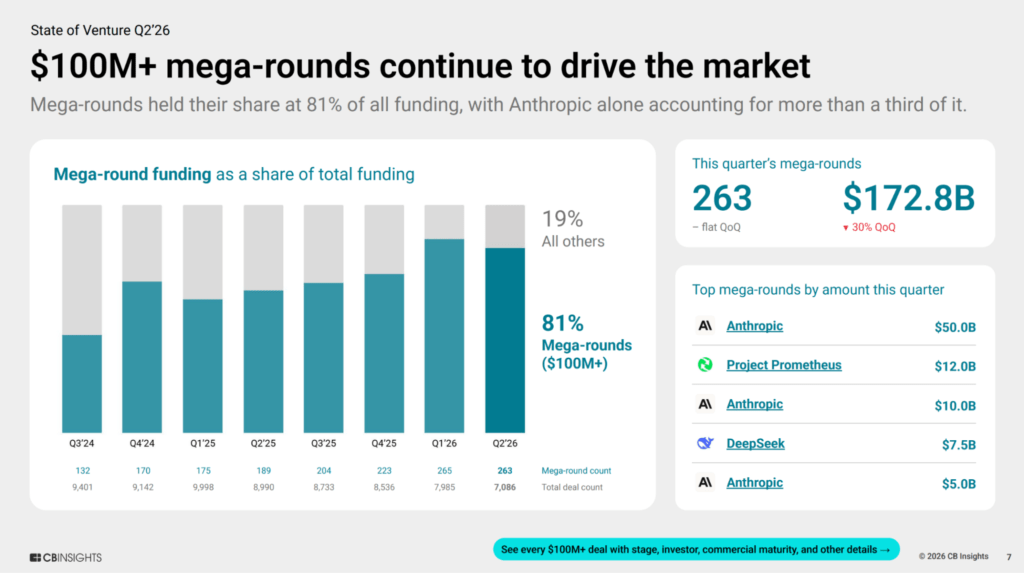
The most prominent example of this distortion is the AI powerhouse Anthropic. In Q2 2026 alone, the company secured a staggering $65 billion, catapulting its valuation to an unprecedented $965 billion. When isolating this single transaction, the narrative of a healthy, distributed market falls apart. Anthropic accounted for more than one-third of all venture dollars deployed during the quarter.
This trend of hyper-concentration is not an anomaly; it is the new standard. Mega-rounds—defined as deals exceeding $100 million—captured 81% of all venture funding in Q2. When the vast majority of capital is funneled into a few “national champion” AI companies, the remaining market is left to compete for the scraps. Consequently, while the dollar volume remains high, the number of individual deals has plummeted to a decade-long low. Exits, the lifeblood of the venture cycle, have also faltered for the second consecutive quarter, signaling a cooling IPO market and a potential liquidity crunch for earlier-stage startups.
Helsing and the Rise of European Defense Tech
While general software and consumer tech face a period of correction, one sector is experiencing a seismic shift in capital allocation: defense technology.
Munich-based Helsing, a leader in AI-powered defense software, made history this week by closing a $1.8 billion Series E round. This transaction represents the largest private defense-tech round ever recorded in Europe, bringing the company’s total cumulative funding to $3.3 billion and valuing the firm at $18 billion.
The magnitude of this round is symbolic of a broader ideological shift within the European venture capital community. Just five years ago, the European startup ecosystem was largely defined by ESG (Environmental, Social, and Governance) constraints. During that period, many venture firms explicitly excluded defense contractors from their portfolios, citing reputational risks and the ethical implications of financing weapons systems.
Today, that cultural aversion has dissolved in the face of geopolitical necessity. As European nations seek to modernize their military infrastructure and reduce reliance on external suppliers, defense tech has moved from the periphery to the center of the continent’s strategic agenda. In 2025, European defense startups raised $3.2 billion, a 37% year-over-year increase and a threefold jump compared to 2020. The number of unique investors participating in these rounds has also tripled, signaling that "defense" is no longer a dirty word in the boardrooms of top-tier VCs.
Chronology: From Ethical Aversion to Strategic Priority
- 2020–2021 (The ESG Era): Defense tech startups struggle to gain traction with European VCs. Stricter LP requirements and a general "peace dividend" mindset lead to a scarcity of capital for dual-use and defense-specific technologies.
- 2022–2023 (The Geopolitical Pivot): Russia’s invasion of Ukraine forces a rapid re-evaluation of European security. Governments begin signaling a need for domestic technology sovereignty, particularly in AI, aerospace, and autonomous systems.
- 2024 (The Infrastructure Build): Helsing and other defense-tech leaders begin proving the efficacy of their software in real-world scenarios, demonstrating that AI can be applied to battlefield logistics, electronic warfare, and threat detection.
- 2025 (The Growth Surge): Investment in European defense tech hits $3.2 billion. Institutional investors, including sovereign wealth funds and pension funds, begin to view defense tech as a core pillar of "sovereign innovation."
- July 2026 (The Record Breaker): Helsing’s $1.8 billion Series E confirms that defense tech is now a "mega-round" category, rivaling the capital intensity of the generative AI sector.
Supporting Data: The Concentration Trap
To understand the current market, one must look at the math behind the deals. The data from Q2 2026 confirms that the "average" startup is facing its toughest fundraising environment in a decade.
- The Concentration Ratio: 81% of all venture dollars were captured by mega-rounds. If you exclude the top 1% of recipients, the available capital pool for the rest of the market has shrunk significantly.
- The Anthropic Effect: With $65 billion raised, Anthropic alone represents nearly 30.5% of the total global quarterly funding volume.
- Deal Flow: Deal counts are at a ten-year low, suggesting that VCs are focusing their remaining capital on "bridge" rounds for existing portfolio companies rather than searching for new, high-risk ventures.
- The Defense Trajectory: The 3x increase in unique investors in defense since 2020 highlights a total reversal of the ESG-driven exclusion strategies that dominated the early 2020s.
Official Perspectives and Market Implications
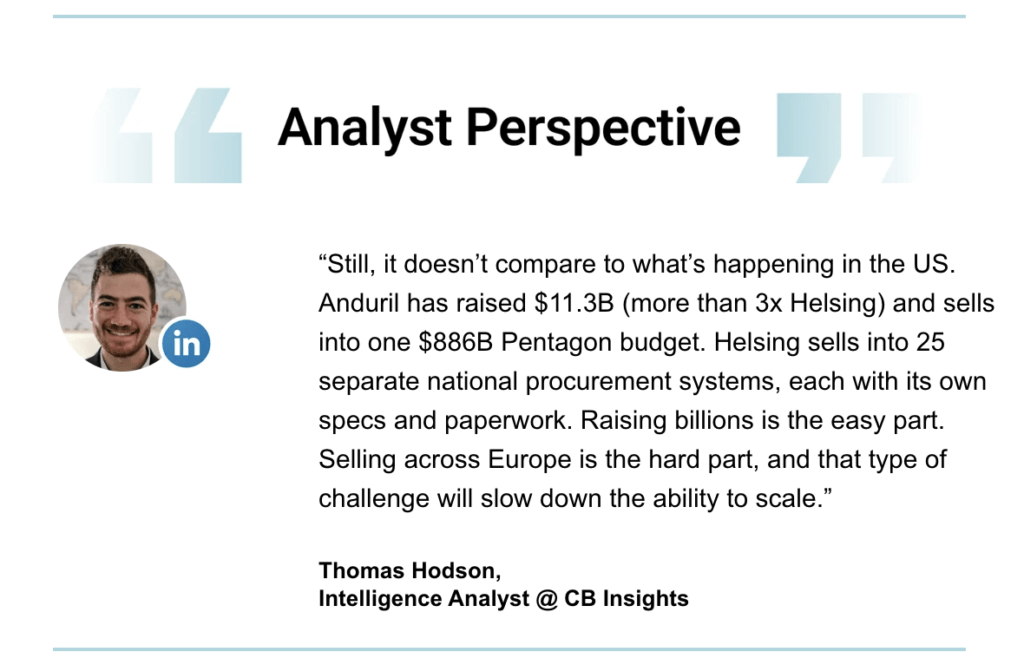
The transition toward a defense-heavy venture landscape has significant implications for both policymakers and founders. Helsing’s success is not merely a testament to their technology, but to their ability to navigate complex, fragmented procurement systems. Unlike consumer software, where a single product can scale globally, defense tech requires deep integration with multiple national procurement systems—each with its own regulatory, security, and bureaucratic hurdles.
Scaling across these systems is a far more effective moat than simply raising capital. Analysts note that while the $1.8 billion round provides the runway necessary for R&D, the true value of Helsing lies in its ability to become a "strategic partner" to European ministries of defense.
Furthermore, the concentration of capital in companies like Anthropic, OpenAI, and now Helsing suggests that the venture market is entering a "Winner-Takes-Most" phase. In an environment where the cost of compute and the barrier to entry for high-end defense systems are so high, only a few players can survive.
For the healthcare sector, this same trend toward "strategic intelligence" is being reflected in partnerships like the collaboration between CB Insights and HLTH USA. As industries become more data-intensive, the ability to parse noise from signal becomes the most valuable asset. The "Insights Hub" developed for the 2026 conference is a prime example of how stakeholders are looking to navigate this high-concentration, high-stakes environment by using data to identify meaningful connections before the show floor even opens.
The Path Forward: A New Era of "Hard Tech"
The dual narrative of Q2 2026—the hyper-concentration of AI capital and the explosive growth of defense tech—paints a picture of a world moving toward extreme strategic focus.
The era of "easy money" for broad-based SaaS platforms is effectively over. In its place, we are seeing the rise of a venture market that prioritizes national security, sovereign AI infrastructure, and companies capable of executing massive, complex contracts with government entities.
For founders, the lesson is clear: if you are not building in a sector that is deemed "strategically essential," the path to capital will continue to narrow. Conversely, for those building in defense, energy, or critical infrastructure, the current market represents a historic opportunity. The capital is there, the regulatory barriers are falling, and the demand from global powers for technological sovereignty has never been higher.
As we look toward the remainder of 2026, the question is no longer "who can raise the most money," but "who can build the most essential infrastructure." Helsing has set the bar. The rest of the market, it seems, is still trying to catch up.