NEW YORK CITY — Standing within the hallowed, neoclassical halls of the Federal Hall National Memorial—the very site where the First Congress met and the Bill of Rights was proposed—modern lawmakers gathered this week to address a different kind of foundational framework. One year after the U.S. House of Representatives passed the CLARITY Act with a surprising surge of bipartisan support, the push for a definitive digital asset regulatory structure has returned to its roots, underscored by a sense of mounting frustration over legislative inertia in the United States Senate.
The hearing, titled “Building the Future of Finance: How the CLARITY Act Unlocks Innovation,” served as both a commemorative milestone and a pointed critique of Washington’s inability to transform political will into enforceable law. While the House has signaled its readiness to integrate digital assets into the national economy, the lack of a Senate companion has left the American blockchain industry in a state of "regulatory limbo," a condition that witnesses and lawmakers argue is actively driving innovation offshore.
I. Main Facts: A Bipartisan Mandate in Limbo
The CLARITY Act (formally understood as a cornerstone of the broader effort to establish market structure for digital assets) represents one of the most significant attempts by the U.S. government to define the boundaries between securities and commodities in the digital age. Its primary objective is to provide a "check-the-box" roadmap for developers, exchanges, and investors, moving away from the "regulation by enforcement" model that has characterized the Securities and Exchange Commission’s (SEC) approach over the last decade.
The Core Objectives of the Act:
- Asset Classification: Establishing clear metrics to determine when a digital asset is a commodity (regulated by the CFTC) versus a security (regulated by the SEC).
- Consumer Protection: Implementing rigorous standards for disclosures, custody, and the prevention of commingling client funds—lessons learned directly from the 2022 collapse of major offshore exchanges.
- Institutional Integration: Providing the legal certainty required for traditional financial institutions, such as pension funds and major banks, to participate in digital asset markets without fear of retroactive regulatory penalties.
- National Security and Competitiveness: Ensuring the United States remains the global hub for financial technology, countering the aggressive regulatory frameworks already established in the European Union (MiCA) and various Asian markets.
Despite these objectives and a robust House vote that saw 78 Democrats join the Republican majority—a rarity in a hyper-polarized Congress—the bill has stalled. As the one-year anniversary of that vote passes, the legislative "certainty" promised by proponents remains purely aspirational, leaving the U.S. market in a defensive posture.
II. Chronology: From Momentum to Stagnation
The journey of the CLARITY Act reflects the broader, turbulent history of digital asset policy in Washington. To understand the current stalemate, one must look at the timeline of its development and the shifting political winds.
Summer 2023: The Breakthrough
In July 2023, the House Financial Services Committee and the House Agriculture Committee achieved what many thought impossible: a unified bill that addressed the jurisdictional overlap between the SEC and the CFTC. The subsequent floor vote was a watershed moment. The "Yes" votes from nearly 80 Democrats signaled that digital asset regulation had moved from a niche libertarian interest to a mainstream policy priority.
Autumn 2023 – Spring 2024: The Senate Silence
Following the House victory, the bill moved to the Senate, where it was greeted by a complex political landscape. While individual Senators like Cynthia Lummis (R-WY) and Kirsten Gillibrand (D-NY) have championed similar frameworks, the Senate Banking Committee, led by Chairman Sherrod Brown (D-OH), has maintained a cautious, and at times skeptical, stance toward the industry. During this period, the SEC continued its string of high-profile lawsuits against domestic exchanges, further heightening the industry’s demand for legislative intervention.
July 17, 2024: The Federal Hall Hearing
Lawmakers chose Federal Hall in New York City for the anniversary hearing to emphasize the historical stakes. By convening in the heart of the world’s financial capital, the House Financial Services Committee sought to bridge the gap between Washington policy and Wall Street reality. The hearing featured testimony from legal experts and industry leaders who argued that the "wait-and-see" approach in the Senate is no longer a viable strategy.
III. Supporting Data: The Cost of Uncertainty
The push for the CLARITY Act is not merely driven by ideology; it is backed by qualitative and quantitative shifts in the global digital asset landscape. Proponents of the bill point to several data points that underscore the urgency of the situation.
The "Brain Drain" and Capital Flight
According to industry reports from venture capital firms like a16z and Electric Capital, the U.S. share of the global blockchain developer population has been steadily declining. In 2018, nearly 40% of the world’s crypto developers were based in the U.S.; by 2024, that number has dropped toward 25%. Industry leaders at the Federal Hall hearing argued that this migration is a direct result of the "unpredictable" regulatory environment.
Comparative Regulatory Progress
The U.S. is currently lagging behind its peers in providing a comprehensive framework:
- European Union: The Markets in Crypto-Assets (MiCA) regulation is already being phased in, providing a single set of rules for 27 nations.
- United Kingdom: The Financial Services and Markets Act 2023 has paved the way for the UK to regulate stablecoins and crypto-assets as regulated activities.
- Hong Kong and Singapore: Both regions have launched robust licensing regimes for retail and institutional trading.
Institutional Demand vs. Access
The successful launch of Bitcoin and Ethereum Spot ETFs in 2024 demonstrated massive institutional appetite for digital assets. However, witnesses at the hearing noted that while "wrapped" products like ETFs are successful, the underlying infrastructure—the ability for a company to launch a decentralized network or for a bank to custody assets directly—remains hampered by the lack of the market structure defined in the CLARITY Act.
IV. Official Responses: Lawmakers and Industry Leaders
The Federal Hall hearing provided a platform for some of the most influential voices in financial policy to voice their concerns. The rhetoric was sharp, with a clear focus on the Senate’s inaction.
The Legislative Perspective
House Majority Whip Tom Emmer (R-MN) was blunt in his assessment of the delay. He characterized the House’s bipartisan vote as a mandate that the Senate has chosen to ignore. "The House has done its work," Emmer suggested, placing the burden of proof on Senate leadership to explain why a bill with such broad support has not seen a committee markup or a floor vote.
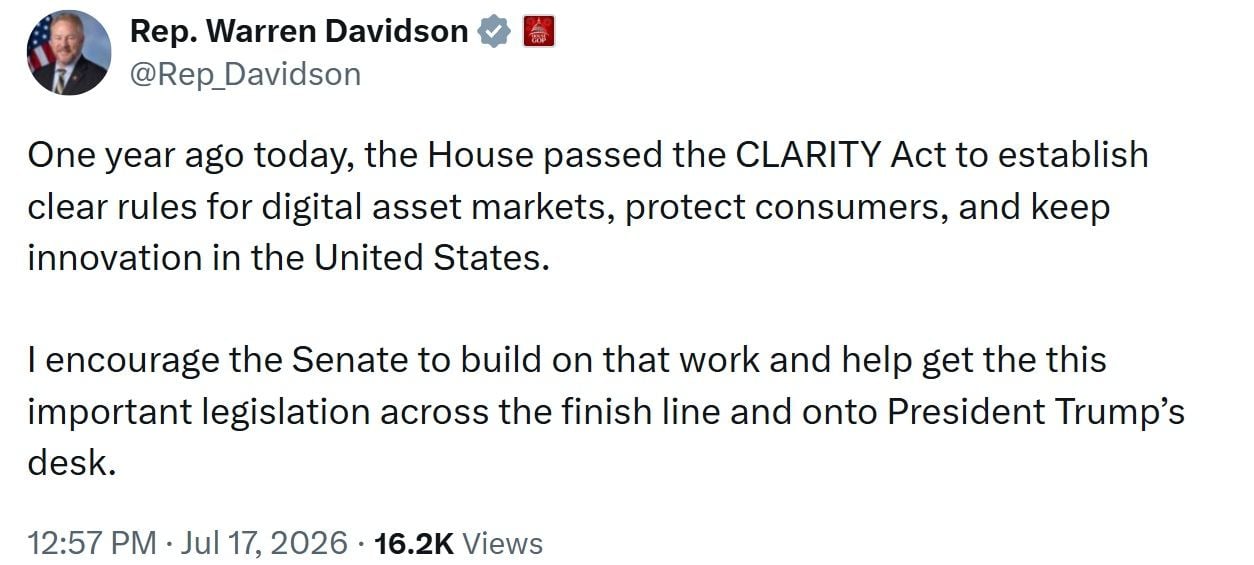
Rep. Warren Davidson (R-OH) framed the anniversary as a test of American governance. He argued that the CLARITY Act is not about "deregulation," but about "right-regulation." Davidson emphasized that without a clear path to compliance, the U.S. is effectively ceding its role as a financial leader.
Rep. Bryan Steil (R-WI) highlighted the maturity of the technology. “Blockchain technology has now existed for more than 15 years,” Steil noted. “It’s no longer a theoretical concept; it’s a practical technology powering real businesses. Yet, entrepreneurs are still facing significant uncertainty.”
The "Cell Phone" Analogy
Chairman French Hill (R-AR) provided the most resonant metaphor of the day. He compared the current legislative landscape to a fragmented technological rollout. Hill noted that even if the U.S. passes specific laws for stablecoins (referencing the GENIUS Act and other dollar-backed stablecoin initiatives), they would be ineffective without the CLARITY Act’s market structure.
"If you have a dollar-backed stablecoin… but you do not have a market structure bill, you have passed authorization to have a cellphone but no cell network," Hill explained. "There is no ecosystem to support the use. That’s why it’s so critical that we get the companion legislation married to the implementation of stablecoins."
Witness Testimony
The witnesses represented a cross-section of the digital economy:
- Sarah Aberg (Nova Labs): Focused on how decentralized physical infrastructure (DePIN) requires clear rules to thrive.
- Ryan Louvar (WisdomTree): Discussed the hurdles asset managers face when trying to bring the efficiency of blockchain to traditional investment products.
- Jason Somensatto (Coin Center): Reaffirmed the need to protect the rights of individual developers and the privacy of users within a regulated framework.
V. Implications: The Path Forward or the Path Away
The anniversary of the CLARITY Act’s House passage serves as a sobering reminder of the "innovation gap" currently widening between the United States and the rest of the world. The implications of continued delay are multifaceted.
Structural vs. Speculative Growth
The primary implication of the CLARITY Act is structural. Unlike news of an ETF approval, which often serves as a price catalyst for crypto-assets, the passage of the CLARITY Act would be a "foundation catalyst." It would allow for the build-out of the "network" Chairman Hill described—permitting clearinghouses, custody providers, and secondary markets to operate with the same legal backing as the New York Stock Exchange.
The Risk of "Regulation by Default"
In the absence of Congressional action, the U.S. court system has become the de facto regulator. Recent rulings in cases involving Ripple, Grayscale, and Coinbase have provided piecemeal clarity, but judicial decisions are a poor substitute for comprehensive legislation. They create a "patchwork" of precedents that can be overturned or interpreted differently across different circuits, adding to the very confusion the CLARITY Act seeks to eliminate.
The Political Horizon
As the 2024 election cycle intensifies, the window for Senate action in the current Congress is closing. Proponents hope that the bipartisan nature of the House vote will eventually force the Senate’s hand, perhaps in a "lame-duck" session or as part of a larger end-of-year legislative package.
However, the ultimate takeaway from the Federal Hall hearing was one of missed opportunity. If the CLARITY Act remains a "House-only" achievement, the anniversary will not be remembered as a stepping stone to innovation, but as a marker of the moment when American financial policy failed to keep pace with the digital revolution. For the developers and investors watching from the sidelines, the message is clear: until the Senate moves, the "future of finance" may continue to be built everywhere but in the United States.