The American consumer landscape is currently undergoing a profound transformation, driven not by traditional market cycles, but by a pervasive sense of economic anxiety linked to the federal government’s aggressive trade agenda. Since President Trump’s election in November 2024, the administration has consistently signaled a commitment to broad-based tariffs—a policy move that economists and retail analysts have long warned could trigger inflationary pressure. As these policies move from campaign rhetoric to concrete implementation, the ripple effects are being felt in living rooms across the nation, manifesting as a frantic rush to stockpile household goods, accelerated large-scale purchases, and an alarming rise in "doom spending."
A comprehensive survey conducted in April 2025 by CreditCards.com, involving 1,000 U.S. adults, highlights a public increasingly convinced that the cost of living is on a collision course with rising import costs. This report, which tracks evolving sentiment from previous surveys in December 2024 and February 2025, suggests that the fear of a potential recession and the erosion of purchasing power are no longer abstract concerns—they are dictating the daily financial habits of millions of Americans.
A Chronology of Economic Unease: From Campaign Trail to Market Volatility
To understand the current state of consumer behavior, one must look at the timeline of events that have defined the first half of 2025. During his 2024 campaign, President Trump framed tariffs as a necessary tool to protect domestic industry and leverage international trade negotiations. However, as the administration began to formalize these plans in early 2025, the market’s reaction was immediate and negative.
In April 2025, the formal announcement of specific, sweeping tariff plans sent the stock market into a tailspin. This volatility served as the catalyst for the current wave of consumer panic. While the administration maintains that these policies will bolster the U.S. economy in the long term, the immediate psychological impact on the average household has been one of defensive posturing. The sequence of events—starting with the post-election transition, followed by inflationary warnings in December, and culminating in the April market shock—has created a "perfect storm" of consumer uncertainty.
The Stockpiling Phenomenon: Preparing for the Price Hike
The most visible consequence of this uncertainty is the return of mass stockpiling, a behavior previously associated with the early months of the COVID-19 pandemic. According to the April 2025 data, 37% of Americans have already begun hoarding essential goods, with an additional 14% planning to start in the near future. This behavior is not distributed equally across the political spectrum; data indicates that voters who supported Kamala Harris are significantly more likely (44%) to engage in stockpiling than those who supported President Trump (31%).
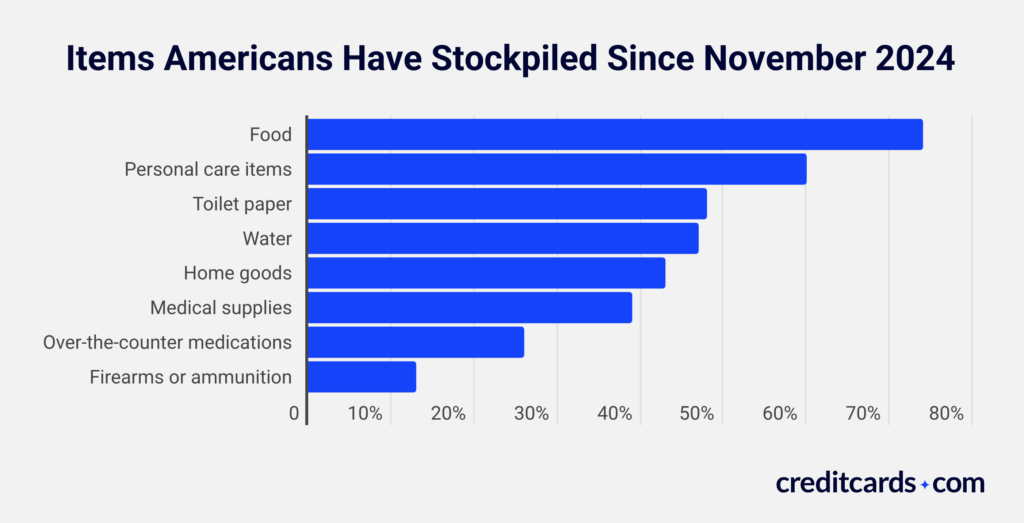
The inventory list of the modern American "prepper" is telling. Food remains the primary target, with 74% of respondents prioritizing pantry staples. This is followed by:

- Personal care items: 60%
- Toilet paper: 48%
- Water: 47%
- Home goods: 43%
- Medical supplies and OTC medications: 39% and 26%, respectively
- Firearms and ammunition: 13%
John Egan, a personal finance expert for CreditCards.com, emphasizes that this reaction, while grounded in a rational fear of rising prices, carries its own financial risks. "Fear of rising prices causes many people to stockpile all sorts of items, from toilet paper to electronics," Egan notes. "While it makes sense to stockpile certain items to avoid tariffs, only buy what you actually need and will actually use. Otherwise, you might wind up overspending."
Large Purchases: Beating the Tariff Clock
Beyond basic household supplies, the fear of impending price hikes has accelerated the timeline for major investments. Nearly half of all Americans (48%) have made a purchase exceeding $500 since November 2024. These are not impulse buys; they are calculated, defensive moves designed to secure assets before tariff-related price surges take full effect.
Electronics (22%) and home improvement materials (18%) top the list of large-ticket items. Other significant purchases include appliances, cars, furniture, and residential real estate. The data reveals that 58% of those who made these large purchases cited the fear of rising prices as a contributing factor, with 36% describing that fear as the "major" driver of their decision. This trend suggests that consumers are essentially "front-loading" their consumption, effectively pulling future demand into the present.
The "Doom Spending" Trap and Rising Debt
Perhaps the most concerning shift identified by the survey is the emergence of "doom spending"—the act of spending money to cope with anxiety, fear, or general pessimism about the future of the economy. While 5% of Americans classify their recent behavior explicitly as doom spending, a combined 32% either identify with the term or are unsure if their spending habits fall under that umbrella.
This emotional spending is fueling a concerning trajectory for household debt. Nearly 3 in 10 Americans (28%) explicitly stated that they are likely to either enter into or further worsen their credit card debt over the course of 2025. When combined with the fact that 15% of Americans plan to increase their spending in the coming months, the potential for a localized debt crisis within households is significant.
Egan warns that the psychological urge to spend as a coping mechanism is one of the most dangerous habits during times of inflation. "Economic uncertainty often causes people to cut back on spending. But amid the threat of tariffs on U.S. imports, some people might stockpile, make big purchases, or engage in ‘doom spending,’" he says. "Unfortunately, these behaviors can lead to piling up credit card debt. Ideally, you should use cash for purchases in situations like this and set aside as much money in savings as you’re able to."
Implications for the Broader Economy
The implications of these findings are far-reaching. When consumers lose confidence in price stability, their behavior shifts from "investing and saving" to "hoarding and protecting." This creates a feedback loop: as consumers rush to buy goods, demand spikes, which can exacerbate the very inflation they are trying to avoid.
Furthermore, the disparity in behavior between political cohorts suggests that economic anxiety has become deeply polarized. The fact that Harris voters are nearly twice as likely to engage in "doom spending" compared to Trump voters (26% vs. 14%) implies that the perception of the economy is heavily filtered through a political lens. This, in turn, makes it more difficult for policymakers to communicate effectively or for the market to achieve a sense of equilibrium.
Looking Ahead: Managing Personal Finance in a Tariff-Heavy Environment
For the average American, the current environment demands a higher degree of fiscal discipline. As the administration’s tariff policies continue to unfold, the pressure on personal balance sheets is likely to increase. Financial experts recommend several strategies to navigate this period of volatility:
- Prioritize High-Interest Debt: Before allocating funds to large, tariff-defensive purchases, ensure that existing high-interest credit card debt is addressed.
- Distinguish Between Needs and Wants: While buying a dishwasher now to avoid a potential 10% price hike may be logical, "doom spending" on non-essential items provides only temporary emotional relief while causing long-term financial damage.
- Build a Liquidity Buffer: In an uncertain economy, cash is king. Prioritizing emergency savings over speculative stockpiling can provide the flexibility needed to handle future price fluctuations.
- Use Tools Wisely: Utilizing resources like the CardMatch™ tool or shopping for the best credit card rewards can help offset some of the costs, but these should be used as financial aids rather than excuses to increase overall debt levels.
As the nation moves deeper into 2025, the "tariff effect" will likely remain a dominant theme in the lives of American consumers. The data is clear: fear is a powerful motivator, and for many, the instinct to prepare for an uncertain future is already resulting in tangible changes to how they earn, save, and spend. The challenge for the individual, in the face of macro-economic policy changes, remains the same: maintaining a clear head and avoiding the traps of impulsive, fear-driven spending.
Methodology: The Consumer Sentiment Post Trade War Poll was conducted by YouGov using a nationally representative sample of 1,000 U.S. adults interviewed online between April 11 and April 14, 2025. The adjusted margin of error for a sample percentage based on the entire sample is approximately 3.57%.
Disclaimer: This report is for informational purposes and does not constitute financial advice. Readers are encouraged to review their personal financial situations and consult with a professional advisor when making significant economic decisions.